Toyota Safety Sense 3.0
Automatic High Beam (AHB)Switches
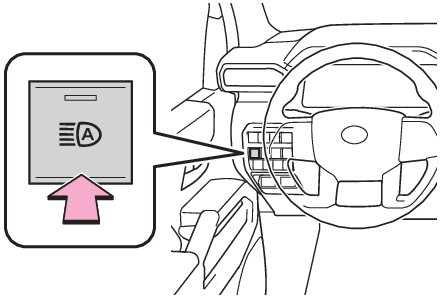
Automatic High Beam switchSensor
Automatic High Beam (AHB)Lights
Automatic High Beam (AHB)Headlights
Automatic High Beam (AHB)Automatic High Beam (AHB)AHB (Automatic High Beam)The Automatic High Beam uses a front camera located on the upper portion of the windshield
to detect the brightness of the lights of vehicles ahead, streetlights, etc., and
automatically changes the head lights between the high beams and low beams.Warning:For safe useDo not overly rely on the Automatic High Beam. Always drive safely, taking care to
observe your surroundings and turning the high beams on or off manually if necessary.To prevent unintentional operation of the Automatic High Beam SystemWhen it is necessary to disable the system: When it is necessary to disable the systemUsing the Automatic High Beam SystemPress the Automatic High Beam switch.Turn the headlight switch to the
or
position.When the headlight switch lever is in the low beam position, the AHB system will be
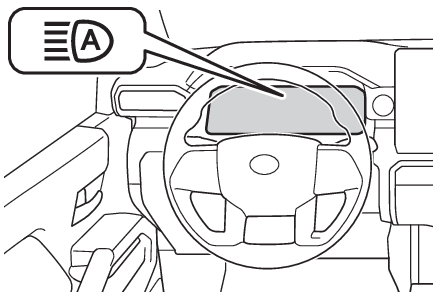
enabled and the AHB indicator will illuminate.Note:Automatic operating conditions of the high beamsWhen all of the following conditions are met, the high beams will illuminate automatically:The vehicle speed is approximately 21 mph (34 km/h) or more.The area ahead of the vehicle is dark.There are no vehicles ahead with lights on.There are few streetlights or other lights on the road ahead.If any of the following conditions are met, the headlights will change to the low
beams:Vehicle speed drops below approximately 17 mph (27 km/h).The area ahead of the vehicle is not dark.There is a vehicle ahead with lights on.There are many streetlights or other lights on the road ahead.Front camera detectionIn the following situations, the high beams may not be automatically changed to the
low beams:When a vehicle cuts in front of your vehicleWhen another vehicle crosses in front of the vehicleWhen vehicles ahead are repeatedly detected and then hidden due to repeated curves,
road dividers or roadside treesWhen a vehicle ahead approaches from a far laneWhen a vehicle ahead is far awayWhen a vehicle ahead has no lightsWhen the lights of a vehicle ahead are dimWhen a vehicle ahead is reflecting strong light, such as own headlightsSituations in which the sensors may not operate properly: Situations in which the sensors and the systems may not operate properlyThe headlights may change to the low beams if a vehicle ahead that is using fog lights
without its headlights turned on is detected.House lights, street lights, traffic signals, and illuminated billboards or signs
may cause the high beams to change to the low beams, or the low beams to remain on.The following may change the timing at which the headlights change to the low beams:The brightness of lights of vehicles aheadThe movement and direction of vehicles aheadThe distance between the vehicle and a vehicle aheadWhen a vehicle ahead only has lights illuminated on one sideWhen a vehicle ahead is a two-wheeled vehicleThe condition of the road (gradient, curve, condition of the road surface, etc.)The number of passengers and amount of luggageThe headlights may change between the high beams and low beams unexpectedly.Bicycles and other small vehicles may not be detected.In the following situations, the system may not be able to correctly detect the brightness
of the surroundings. This may cause the low beams to remain on or the high beams to
flash or dazzle pedestrians or vehicles ahead. In such a case, it is necessary to
manually change between the high beams and low beams.When there are lights similar to headlights or tail lights in the surrounding areaWhen headlights or tail lights of vehicles ahead are turned off, dirty, changing color,
or not aimed properlyWhen the headlights are repeatedly changing between the high beams and low beams.When use of the high beams is inappropriate or when the high beams may be flashing
or dazzling pedestrians or other drivers.When the vehicle is used in an area in which vehicles travel on the opposite side
of the road of the country for which the vehicle was designed, for example using a
vehicle designed for right-hand traffic in a left-hand traffic area, or vice versaWhen it is necessary to disable the system: When it is necessary to disable the systemSituations in which the sensors may not operate properly: Situations in which the sensors and the systems may not operate properlyTemporarily reducing front camera sensitivityThe sensitivity of the front camera can be temporarily reduced.Turn the engine switch off with the following conditions met.The headlight switch is in the
or
position.The headlight switch lever is in the low beam position.The Automatic High Beam switch is on.Turn the engine switch to ON.Within 60 seconds after performing step 2, push the headlight switch lever to the high beam position then pull it to the original
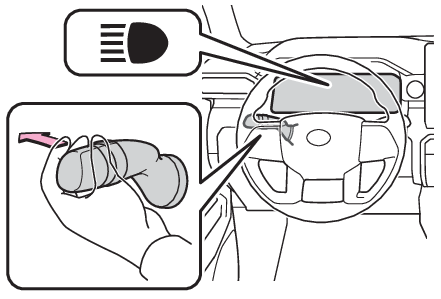
position quickly 10 times, then leave the lever in its original position.If the sensitivity is changed, the Automatic High Beam indicator will blink 3 times.Turning the high beams on/off manuallyChanging to the high beamsPush the lever forward.The AHB indicator will turn off and the high beam indicator will turn on.Pull the lever to its original position to enable the Automatic High Beam system again.Changing to the low beamsPress the Automatic High Beam switch.The AHB indicator will turn off.Press the switch to enable the Automatic High Beam system again.Temporarily changing to the low beamsIt is recommended to switch to the low beams when use of the high beams is inappropriate
or when the high beams may cause problems or distress to other drivers or pedestrians
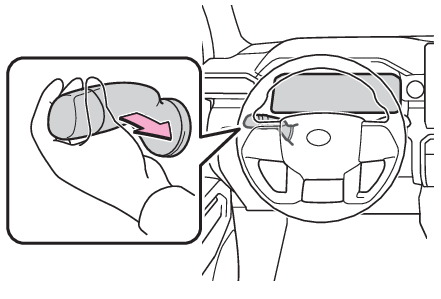
nearby.Pull the lever rearward and then return it to its original position.The high beams will illuminate while the lever is pulled, however, after the lever
is returned to its original position, the low beams will remain on for a certain amount
of time. After this, the Automatic High Beam system will operate.