RCD (Rear Camera Detection)Rear Camera Detection (RCD)RCD (Rear Camera Detection)**If equippedWhen the vehicle is backing up, the rear camera detection function can detect pedestrians
in the detection area behind the vehicle. If a pedestrian is detected, a buzzer will
sound and an icon will be displayed on the multimedia display to inform the driver
of the pedestrian.Warning:Cautions regarding the use of the systemThe recognition and control capabilities for this system are limited.The driver should always drive safely by always being responsible without over relying
on the system and have a understanding of the surrounding situations.To ensure the system can operate properlyObserve the following, otherwise there is the danger that could lead to an accident.Always clean the camera without damaging it.Do not install market electronic parts (such as Illuminated license plate, fog lamps,
etc.) in the camera vicinity.Do not subject the camera vicinity to strong impacts. If the vicinity is subjected
to a strong impact, have the vehicle inspected by your Toyota dealer.Do not disassemble, remodel or paint the camera.Do not attach accessories or stickers to the camera.Do not install market protection parts (bumper trim, etc.) to the rear bumper.Maintain suitable tire air pressure.Make sure the tailgate is completely closed.RCD function is turned offIn the following situations the system turns off. The RCD function may not operate
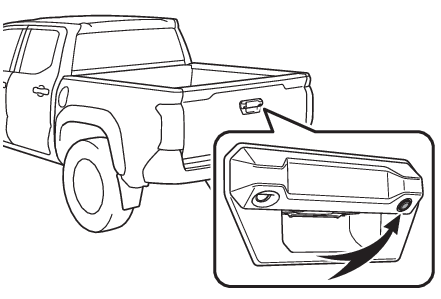
properly and thus there is the danger that an accident may occur.The contents mentioned above are not observed.Suspensions other than the genuine parts are installed.When towing a trailerWhen Auto Trailer Detection (ATD) (Auto Trailer Detection (ATD)) is activated, the function automatically turns off.System componentLocation of the rear cameraDisplay
RCD (Rear Camera Detection)Display
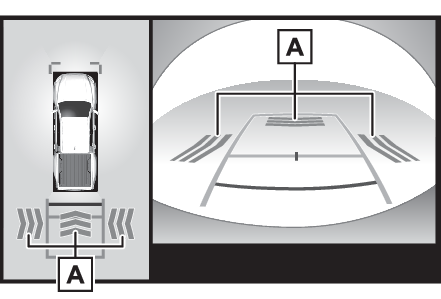
Rear Camera Detection (RCD)RCD displayPedestrian detection iconDisplayed automatically when a pedestrian is detected behind the vehicle.RCD (Rear Camera Detection)
Enabling/disabling the systemRear Camera Detection (RCD)
Enabling/disabling the systemTurning the RCD function on/offThe RCD function can be enabled/disabled through a customize setting. (Customizable features)When the RCD function is disabled, the driving assist information indicator (Indicators) illuminates, and a message is displayed on the multi-information display.Each time the engine switch is turned off then changed to ON, the RCD function will
be enabled automatically.When a pedestrian is detectedIf a pedestrian is in the area behind the vehicle or if the rear camera detected that
a pedestrian is approaching the vehicle from behind, the system urges caution from
the driver by sounding the buzzer and displaying the detection of a pedestrian on
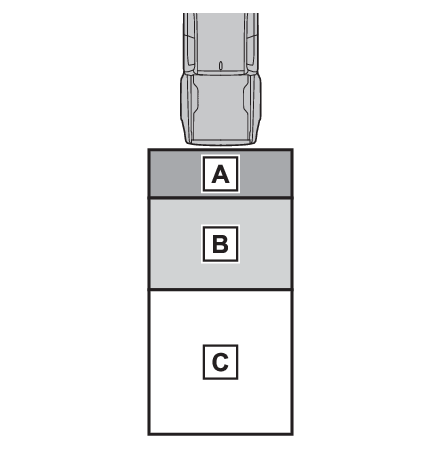
the multimedia display as follows:If a pedestrian is detected in area
Buzzer: Sounds repeatedlyPedestrian detection icon: BlinksIf a pedestrian is detected in area
Buzzer (When the vehicle is stationary): Sounds 3 timesBuzzer (When the vehicle is
backing up, when a pedestrian approaches the rear of the vehicle): Sounds repeatedlyPedestrian
detection icon: BlinksIf the system determines that your vehicle may collide with a pedestrian in area
Buzzer: Sounds repeatedlyPedestrian detection icon: BlinksNote:When towing a trailerWhen Auto Trailer Detection (ATD) (Auto Trailer Detection (ATD)) is activated, the function automatically turns off.When the shift position is in R, the intuitive parking assist OFF indicator (Indicators) turns ON and a message is displayed in the multi-information display.The rear camera detection function is operational whenThe engine switch is in ON.RCD function is on.The shift position is in R.Setting the buzzer volumeThe buzzer volume of the intuitive parking assist, RCTA, and RCD can all be changed
at once from the customize settings. (Customizable features)Muting a buzzer temporarilyWhen an object is detected, the temporary mute switch is displayed on the multimedia
display system. Select the switch to mute a buzzer of the intuitive parking assist,
RCTA, and RCD all together.Mute will be canceled automatically in the following situations:When the shift position is changed.When the vehicle speed exceeds a certain speed.When there is a malfunction in a sensor or the system is temporarily unavailable.When the operating function is disabled manually.When the engine switch is turned off.Situations in which the system may not operate properlySome pedestrians, such as the following, may not be detected by the rear camera detection
function, preventing the function from operating properly:Pedestrians who are bending forward or squattingPedestrians who are lying downPedestrians who are runningPedestrians who suddenly appear from the shadow of the vehicle or a buildingPedestrians who are riding moving objects such as a bicycle or skateboardPedestrians wearing oversized clothing such as a rain coat, long skirt, etc., making
their silhouette obscurePedestrians whose body is partially hidden by an object, such as a cart or umbrellaPedestrians which are obscured by darkness, such as at nightIn some situations, such as the following, pedestrians may not be detected by the
rear camera detection function, preventing the function from operating properly:When backing up in inclement weather (rain, snow, fog, etc.)The lens is dirty (by dirt or snow-melting agent, etc.) or scratchedWhen a very bright light, such as the sun, or the headlights of another vehicle, shines
directly into the rear cameraWhen backing up in a place where the surrounding brightness changes suddenly, such
as at the entrance or exit of a garage or underground parking lotWhen backing up in a dim environment such as during dusk or in an underground parking
lotWhen the camera position and direction are deviatedWhen a towing hook is attachedWhen water droplets are flowing on the camera lensWhen the vehicle height is extremely changed (nose up, nose down, etc.)When tire chains or an emergency tire puncture repair kit are usedWhen the suspension has been lowered or tires that have a different size than the
genuine tires are installedWhen an aftermarket electronic part (backlit license plate, fog light, etc.) is installed
near the rear cameraIf a bumper protector, such as an additional trim strip, is installed to the rear
bumperWhen towing with the vehicleSituations in which the system may operate unexpectedlyEven though there are no pedestrians in the detection area, some objects, such as
the following, may be detected, possibly causing the rear camera detection function
to operate.Three dimensional objects, such as a pole, traffic cone, fence, or parked vehicleMoving objects, such as a car or motorcycleObjects moving toward your vehicle when backing up, such as flags or puddles (or airborne
matter, such as smoke, steam, rain, or snow)Cobblestone or gravel roads, tram rails, road repairs, white lines, pedestrian crossings
or fallen leaves on the roadMetal covers (gratings), such as those used for drainage ditchesObjects reflected in a puddle or on a wet road surfaceShadows on the roadIn some situations, such as the following, the rear camera detection function may
operate even though there are no pedestrians in the detection area.When backing up toward the roadside or a bump on the roadWhen backing up toward an incline/declineWhen the vehicle height is extremely changed (nose up, nose down, etc.)When an aftermarket electronic part (backlit license plate, fog light, etc.) is installed
near the rear cameraIf a bumper protector, such as an additional trim strip, is installed to the rear
bumperIf the orientation of the rear camera has been changed due to a collision or other
impact, or removal and installationIf a towing eyelet is installed to the rear of the vehicleWhen water is flowing over the rear camera lensThe lens is dirty (by dirt or snow-melting agent, etc.)If there is a flashing light in the detection area, such as the emergency flashers
of another vehicleWhen a tire chains or an emergency tire puncture repair kit are usedWhen towing with the vehicleSituations in which the rear camera detection function may be difficult to noticeThe buzzer may be difficult to hear if the surrounding area is noisy or the audio
system volume is high.If the temperature in the cabin is extremely high or low, the audio system screen
may not operate correctly.