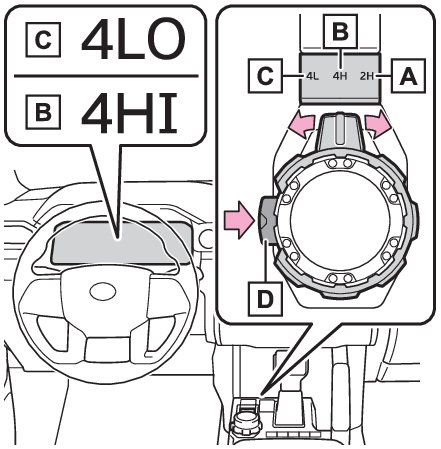
Four-wheel drive systemSwitches
Front-wheel drive control switchFour-wheel drive system**If equippedUse the front-wheel drive control switch to select the following transfer modes:Front-wheel drive control switch“
2H” (high speed position, two-wheel drive)Use this for normal driving on dry hard-surfaced roads. This position gives greater
economy, quietest ride and least wear.Hold down
and turn the dial to select.“
4H” (high speed position, four-wheel drive)Use this for driving only on tracks that permit the tires slide, like off-road, icy
or snow-covered roads. This position provides greater traction than two-wheel drive.The “
4HI” indicator will come on.Hold down
and turn the dial to select.“
4L” (low speed position, four-wheel drive)Use this for maximum power and traction. Use “
4L” for climbing or descending steep hills, off-road driving, and hard pulling in sand,
mud or deep snow.The “
4LO” indicator will come on.Hold down
and turn the dial to select.Shifting between “
2H” and “
4H”Shifting from “
2H” to “
4H”Reduce vehicle speed to less than 62 mph (100 km/h).Push and turn the front-wheel drive control switch to “
4H”.The “
4HI” indicator will come on.Shifting from “
4H” to “
2H”Reduce vehicle speed to less than 62 mph (100 km/h).Push and turn the front-wheel drive control switch to “
2H”.The “
4HI” indicator will go off.Shifting between “
4H” and “
4L”Shifting from “
4H” to “
4L”Vehicles with an Automatic transmissionStop the vehicle completely and continue to depress the brake pedal.Shift the shift lever to N.Push and turn the front-wheel drive control switch to “
4L”.The “
4LO” indicator will come on and the “
4HI” indicator go off.Vehicles with a Manual transmissionStop the vehicle completely and continue to depress the brake pedal.Depress and hold the clutch pedal.Push and turn the front-wheel drive control switch to “
4L”.The “
4LO” indicator will come on and the “
4HI” indicator go off.Shifting from “
4L” to “
4H”Vehicles with an Automatic transmissionStop the vehicle completely and continue to depress the brake pedal.Shift the shift lever to N.Push and turn the front-wheel drive control switch to “
4H”.The “
4LO” indicator will go off and the “
4HI” indicator come on.Vehicles with a Manual transmissionStop the vehicle completely and continue to depress the brake pedal.Depress and hold the clutch pedal.Push and turn the front-wheel drive control switch to “
4H”.The “
4LO” indicator will go off and the “
4HI” indicator come on.Note:When the front-wheel drive control switch is shifted to “
4L”VSC is automatically turned off.If the “
4HI” indicator flashesThe transfer mode may not successfully change. Drive straight ahead while accelerating
or decelerating, or drive in reverse.If the “
4HI” indicator is ON and the “
4LO” indicator continues to flashShift the shift lever to D or R (Vehicles with an Automatic transmission) or 1st gear
or Reverse (Vehicles with a Manual transmission) and drive the vehicle slowly, then
stop.If the “
4HI” indicator continues to flash and the “
4LO” indicator is ONShift the shift lever to D or R (Vehicles with an Automatic transmission) or 1st gear
or Reverse (Vehicles with a Manual transmission) and drive the vehicle slowly, then
stop.If the “
4HI” indicator is ON and the “
4LO” indicator continues to flash and a buzzer soundsThe shift lever is not in N (Vehicles with an Automatic transmission) or the clutch
pedal is not held in the depressed position (Vehicles with a Manual transmission)
and/or the vehicle is moving. Stop the vehicle completely, shift the shift lever to
N and make sure that the indicator stops flashing.If the “
4HI” indicator continues to flash and the “
4LO” indicator is ON and a buzzer soundsThe shift lever is not in N and/or the vehicle is moving. Stop the vehicle completely,
shift the shift lever to N (Vehicles with an Automatic transmission) or the clutch
pedal is not held in the depressed position (Vehicles with a Manual transmission)
and make sure that the indicator stops flashingIf the “
4HI” and “
4LO” indicator flashes rapidlyThere may be a malfunction in the four-wheel drive system. Have the vehicle inspected
by your Toyota dealer immediately.Shift between 4H and 4L at low temperatureImmediately after starting the engine in a low-temperature environment, the shift
between 4H and 4L may be prohibited because the transmission fluid is cold. At that
time, a warning message will be displayed in the multi-information display, so follow
the message and operate the front-wheel drive control switch again after warming up.Four-wheel drive usage frequencyYou should drive in four-wheel drive for at least 10 miles (16 km) each month. This
will assure that the front drive components are lubricated.Warning:Shifting the front-wheel drive control switch from “
2H” to “
4H” while drivingNever operate the front-wheel drive control switch if the wheels are slipping. Stop
the slipping or spinning before shifting.When the vehicle is parked (Vehicles with an Automatic transmission)If the shift lever is moved before the “
4HI” or “
4LO” indicator turns on/off, the transfer mode may not be shifted completely. The transfer
mode disengages both the front and rear driveshafts from the powertrain and allows
the vehicle to move regardless of the shift position. (At this time, the indicator
blinks and the buzzer sounds.)Therefore, the vehicle is free to roll even if the automatic
transmission is in P. You or someone else could be seriously injured. You must complete
the shifting of the transfer mode before placing transmission in P.