Driving assist systemsTo keep driving safety and performance, the following systems operate automatically
in response to various driving situations. Be aware, however, that these systems are
supplementary and should not be relied upon too heavily when operating the vehicle.Summary of the driving assist systemsABS (Anti-lock Brake System)Anti-lock Brake System (ABS)ABS (Anti-lock Brake System)Helps to prevent wheel lock when the brakes are applied suddenly, or if the brakes
are applied while driving on a slippery road surface, or in off-road conditions (such
as rough roads, sand and mud)The ABS operates in synchronization with the Multi-terrain SelectBrake assistBrake assistGenerates an increased level of braking force after the brake pedal is depressed when
the system detects a panic stop situationVSC (Vehicle Stability Control)Helps the driver to control skidding when swerving suddenly or turning on slippery
road surfaces.Enhanced VSC (Enhanced Vehicle Stability Control)Enhanced Vehicle Stability Control (Enhanced VSC)Enhanced VSC (Enhanced Vehicle Stability Control)Provides cooperative control of the ABS, TRAC, VSC and EPS.Helps to maintain directional stability when swerving on slippery road surfaces by
controlling steering performance.Trailer Sway ControlTrailer Sway ControlHelps the driver to control trailer sway by selectively applying brake pressure for
individual wheels and reducing driving torque when trailer sway is detected.TRAC (Traction Control)Traction Control (TRAC)TRAC (Traction Control)Helps to maintain drive power and prevent the drive wheels from spinning when starting
the vehicle or accelerating on slippery roadsHill-start assist controlHill-start assist controlHelps to reduce the backward movement of the vehicle when starting on an uphillAVS (Adaptive Variable Suspension System)Adaptive Variable Suspension System (AVS)AVS (Adaptive Variable Suspension System) (if equipped)The damping force of the shock absorbers are independently controlled for the 4 wheels
according to factors including the road surface conditions and driving operation,
contributing toward enhancing smooth driving comfort and superior stability, and helping
to maintain vehicle posture.In addition, the damping force can be changed by selecting the drive mode with the
driving mode select (Driving mode select switch*), and driving comfort can be ensured during off-road driving by setting the front-wheel
drive control switch to “
4L”.(Shifting between “4H” and “4L”)EPS (Electric Power Steering)Electric Power Steering (EPS)EPS (Electric Power Steering)Employs an electric motor to reduce the amount of effort needed to turn the steering
wheel.The Secondary Collision BrakeThe Secondary Collision BrakeWhen the SRS airbag sensor detects a collision and the system operates, the brakes
and brake lights are automatically controlled to reduce the vehicle speed and help
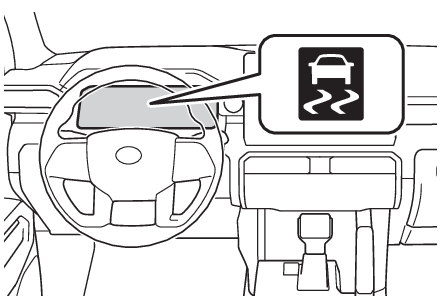
reduce the possibility of further damage due to a secondary collision.Note:When the TRAC/VSC/ABS/Trailer Sway Control systems are operatingThe slip indicator light will flash while the TRAC/VSC/ABS/Trailer Sway Control systems
are operating.Switches
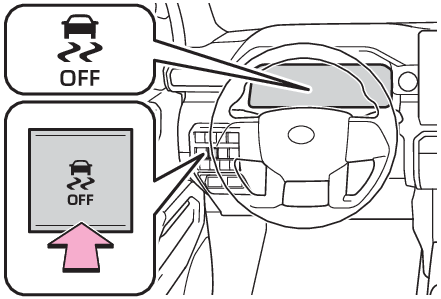
VSC OFF switchDisabling the TRAC systemIf the vehicle gets stuck in mud, dirt or snow, the TRAC system may reduce power from
the engine to the wheels. Pressing
to turn the system off may make it easier for you to rock the vehicle in order to
free it.To turn the TRAC system off, quickly press and release
.“
Traction Control Turned OFF” is displayed in the multi-information display.Press
again to turn the system back on.Turning off the TRAC/VSC/Trailer Sway Control systemsTo turn the TRAC, VSC and Trailer Sway Control systems off, press and hold
for more than 3 seconds while the vehicle is stopped.The “
Traction Control Turned OFF” is displayed in the multi-information display and the VSC OFF indicator light will
come on.*Press
again to turn the system back on.*PCS will also be disabled (only Pre-Collision warning is available). The PCS warning
light will come on and a message will be displayed on the multi-information display.
(PCS warning light (warning buzzer))When the message is displayed on the multi-information display showing that TRAC has
been disabled even if
has not been pressedTRAC is temporary deactivated. If the information continues to show, contact your
Toyota dealer.When using Multi-terrain Select, the “
VSC OFF” indicator will turn on depending on the mode, even if the VSC OFF switch has not
been pressed.Operating conditions of hill-start assist controlWhen the following five conditions are met, the hill-start assist control will operate:Vehicles with an automatic transmission: The shift lever is in a position other than
P or N (when starting off forward/backward on an upward incline)Vehicles with a manual transmission: The shift lever is in a position other than N
or R when starting off forward on an upward incline, or the shift lever is in R when
starting off backward on an upward incline.The vehicle is stoppedThe accelerator pedal is not depressedThe parking brake is not engagedThe engine switch is turned to ONAutomatic system cancelation of hill-start assist controlThe hill-start assist control will turn off in any of the following situations:Vehicles with an automatic transmission: The shift lever is shifted to P or NVehicles with a manual transmission: The shift lever is shifted to R when starting
off forward on an upward incline, or the shift lever is shifted to other than N or
R when starting off backward on an upward incline.The accelerator pedal is depressedThe parking brake is engagedA maximum of 2 seconds have elapsed after the brake pedal is releasedThe engine switch is turned to OFFSounds and vibrations caused by the ABS, brake assist, VSC, Trailer Sway Control,
TRAC and hill-start assist control systemsA sound may be heard from the engine compartment when the brake pedal is depressed
repeatedly, when the engine is started or just after the vehicle begins to move. This
sound does not indicate that a malfunction has occurred in any of these systems.Any of the following conditions may occur when the above systems are operating. None
of these indicates that a malfunction has occurred.Vibrations may be felt through the vehicle body and steering.A motor sound may be heard also after the vehicle comes to a stop.Automatic reactivation of TRAC, Trailer Sway Control and VSC systemsAfter turning the TRAC, Trailer Sway Control and VSC systems off, the systems will
be automatically re-enabled in the following situations:When the engine switch is turned offIf only the TRAC system is turned off, the TRAC will turn on when vehicle speed increasesIf
both the TRAC and VSC systems are turned off, automatic re-enabling will not occur
when vehicle speed increases.Reduced effectiveness of the EPS systemThe effectiveness of the EPS system is reduced to prevent the system from overheating
when there is frequent steering input over an extended period of time. The steering
wheel may feel heavy as a result. Should this occur, refrain from excessive steering
input or stop the vehicle and turn the engine off. The EPS system should return to
normal within 10 minutes.Secondary Collision Brake operating conditionsThe system operates when the SRS airbag sensor detects a collision while the vehicle
is in motion. However, the system does not operate when the components are damaged.Secondary Collision Brake automatic cancelationThe system is automatically canceled in any of the following situations.The vehicle speed drops to approximately 0 mph (0 km/h).A certain amount of time elapses during operationThe accelerator pedal is depressed a large amountWarning:The ABS does not operate effectively whenThe limits of tire gripping performance have been exceeded (such as excessively worn
tires on a snow covered road).The vehicle hydroplanes while driving at high speed on wet or slick roads.Stopping distance when the ABS is operating may exceed that of normal conditionsThe ABS is not designed to shorten the vehicle’s stopping distance. Always maintain
a safe distance from the vehicle in front of you, especially in the following situations:When driving on dirt, gravel or snow-covered roadsWhen driving with tire chainsWhen driving over bumps in the roadWhen driving over roads with potholes or uneven surfacesTRAC/VSC may not operate effectively whenDirectional control and power may not be achievable while driving on slippery road
surfaces, even if the TRAC/VSC system is operating. Drive the vehicle carefully in
conditions where stability and power may be lost.Hill-start assist control does not operate effectively whenDo not overly rely on hill-start assist control. Hill-start assist control may not
operate effectively on steep inclines and roads covered with ice.Unlike the parking brake, hill-start assist control is not intended to hold the vehicle
stationary for an extended period of time. Do not attempt to use hill-start assist
control to hold the vehicle on an incline, as doing so may lead to an accident.When the TRAC/VSC/Trailer Sway Control is activatedThe slip indicator light flashes. Always drive carefully. Reckless driving may cause
an accident. Exercise particular care when the indicator light flashes.When the TRAC/VSC/Trailer Sway Control systems are turned offBe especially careful and drive at a speed appropriate to the road conditions. As
these are the systems to help ensure vehicle stability and driving force, do not turn
the TRAC/VSC/Trailer Sway Control systems off unless necessary.Trailer Sway Control is part of the VSC system and will not operate if VSC is turned
off or experiences a malfunction.Replacing tiresMake sure that all tires are of the specified size, brand, tread pattern and total
load capacity. In addition, make sure that the tires are inflated to the recommended
tire inflation pressure level.The ABS, TRAC, Trailer Sway Control and VSC systems will not function correctly if
different tires are installed on the vehicle.Contact your Toyota dealer for further
information when replacing tires or wheels.Handling of tires and the suspensionUsing tires with any kind of problem or modifying the suspension will affect the driving
assist systems, and may cause a system to malfunction.Trailer Sway Control precautionThe Trailer Sway Control system is not able to reduce trailer sway in all situations.
Depending on many factors such as the conditions of the vehicle, trailer, road surface
and driving environment, the Trailer Sway Control system may not be effective. Refer
to your trailer owner’s manual for information on how to tow your trailer properly.If trailer sway occursObserve the following precautions.Failing to do so may cause death or serious injury.Firmly grip the steering wheel. Steer straight ahead. Do not try to control trailer
sway by turning the steering wheel.Begin releasing the accelerator pedal immediately but very gradually to reduce speed.Do
not increase speed. Do not apply vehicle brakes.If you make no extreme correction with the steering or brakes, your vehicle and trailer
should stabilize. (Trailer towing)Secondary Collision BrakeDo not rely solely upon the Secondary Collision Brake. This system is designed to
help reduce the possibility of further damage due to a secondary collision, however,
that effect changes according to various conditions. Overly relying on the system
may result in death or serious injury.