Winter driving tipsDriving
Winter drive tipsSnow tiresTires
Snow tiresWasher
Preparing and checking before winterBattery
Preparing and checking before winterEngine coolant
Preparing and checking before winterWinter driving tipsCarry out the necessary preparations and inspections before driving the vehicle in
winter. Always drive the vehicle in a manner appropriate to the prevailing weather
conditions.Preparation for winterUse fluids that are appropriate to the prevailing outside temperatures.Engine oilEngine coolantWasher fluidHave a service technician inspect the condition of the battery.Have the vehicle fitted with four snow tires or purchase a set of tire chains for
the rear tires*.*Tire chains cannot be mounted on 265/70R18 tires.Ensure that all tires are the same size and brand, and that chains match the size
of the tires.Warning:Driving with snow tiresObserve the following precautions to reduce the risk of accidents.Failure to do so
may result in a loss of vehicle control and cause death or serious injury.Use tires of the specified size.Maintain the recommended level of air pressure.Do not drive in excess of 75 mph (120 km/h), regardless of the type of snow tires
being used.Use snow tires on all, not just some wheels.4WD models: Do not mix tires of different makes, models, tread patterns or treadwear.Driving with tire chains (vehicles without 265/70R18 tires)Observe the following precautions to reduce the risk of accidents.Failure to do so
may result in the vehicle being unable to be driven safely, and may cause death or
serious injury.Do not drive in excess of the speed limit specified for the tire chains being used,
or 30 mph (50 km/h), whichever is lower.Avoid driving on bumpy road surfaces or over potholes.Avoid sudden acceleration, abrupt steering, sudden braking and shifting operations
that cause sudden engine braking.Slow down sufficiently before entering a curve to ensure that vehicle control is maintained.Do not use LTA (Lane Tracing Assist) (if equipped) system.Notice:Repairing or replacing snow tiresRequest repairs or replacement of snow tires from Toyota dealers or legitimate tire
retailers.This is because the removal and attachment of snow tires affects the operation
of the tire pressure warning valves and transmitters.Before driving the vehiclePerform the following according to the driving conditions:Do not try to forcibly open a window or move a wiper that is frozen. Pour warm water
over the frozen area to melt the ice. Wipe away the water immediately to prevent it
from freezing.To ensure proper operation of the climate control system fan, remove any snow that
has accumulated on the air inlet vents in front of the windshield.Check for and remove any excess ice or snow that may have accumulated on the exterior
lights, outside rear view mirrors, windows, vehicle’s roof, chassis, around the tires
or on the brakes.Remove any snow or mud from the bottom of your shoes before getting in the vehicle.When driving the vehicleAccelerate the vehicle slowly, keep a safe distance between you and the vehicle ahead,
and drive at a reduced speed suitable to road conditions.When parking the vehiclePark the vehicle and move the shift lever to P (automatic transmission) or 1 or R
(manual transmission) without setting the parking brake. The parking brake may freeze
up, preventing it from being released. If the vehicle is parked without setting the
parking brake, make sure to block the wheels.Failure to do so may be dangerous because
it may cause the vehicle to move unexpectedly, possibly leading to an accident.Vehicles with an automatic transmission: If the vehicle is parked without setting
the parking brake, confirm that the shift lever cannot be moved out of P*.*The shift lever will be locked if it is attempted to be shifted from P to any other
position without depressing the brake pedal. If the shift lever can be shifted from
P, there may be a problem with the shift lock system. Have the vehicle inspected by
your Toyota dealer immediately.Warning:When parking the vehicleWhen parking the vehicle without applying the parking brake, make sure to chock the
wheels. If you do not chock the wheels, the vehicle may move unexpectedly, possibly
resulting in an accident.ChainsTires
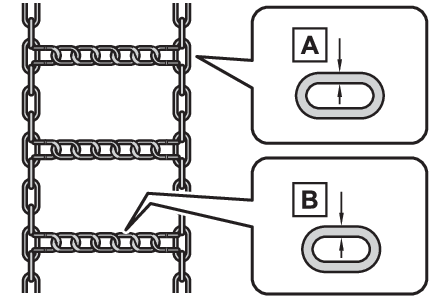
ChainsSelecting tire chainsVehicles without 265/70R18 tiresUse the correct tire chain size when mounting the tire chains.Chain size is regulated
for each tire size.Side chain (0.2 in. [5 mm] in diameter)Cross chain (0.25 in. [6.3 mm] in diameter)Vehicles with 265/70R18 tiresTire chains cannot be mounted as the space between the tire and body is too narrow.Snow tires should be used instead.Regulations on the use of tire chains (vehicles without 265/70R18 tires)Regulations regarding the use of tire chains vary depending on location and type of
road. Always check local regulations before installing chains.Note:Tire chain installationObserve the following precautions when installing and removing chains:Install and remove tire chains in a safe location.Install tire chains on the rear tires. Do not install tire chains on the front tires.Install tire chains on the rear tires as tightly as possible. Retighten chains after
driving 1/41/2 mile (0.51.0 km).Install tire chains following the instructions provided with the tire chains.Notice:Fitting tire chainsThe tire pressure warning valves and transmitters may not function correctly when
tire chains are fitted.