Engine
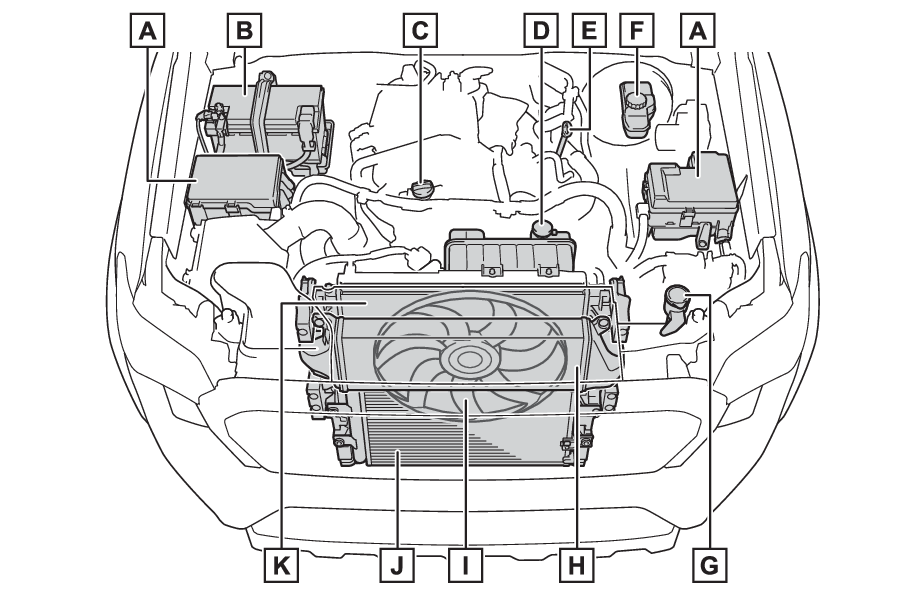
CompartmentEngine compartmentComponentsFuse boxes (Checking and replacing fuses)Battery (Checking the battery)Engine oil filler cap (Checking the engine oil)Engine coolant reservoir (Checking the coolant)Engine oil level dipstick (Checking the engine oil)Brake fluid reservoir (Checking and adding the brake fluid)Washer fluid tank (Adding the washer fluid)Intercooler (Checking the radiator, condenser and intercooler)Cooling fan (Checking the coolant)Condenser (Checking the coolant)Radiator (Checking the radiator, condenser and intercooler)Engine oil
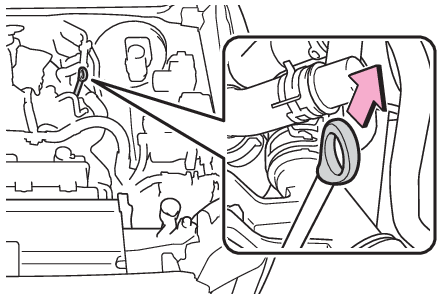
CheckingChecking the engine oilWith the engine at operating temperature and turned off, check the oil level on the
dipstick.Park the vehicle on level ground. After warming up the engine and turning off the
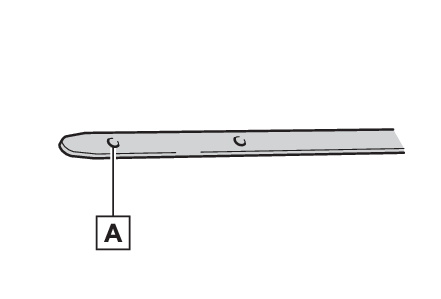
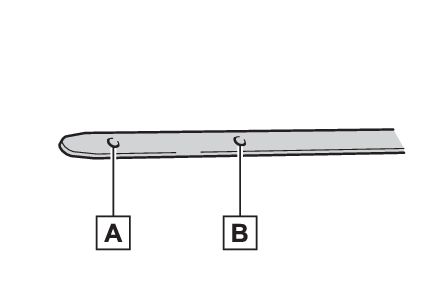
engine, wait about 5 minutes for the oil to drain back into the bottom of the engine.Holding a rag under the end, pull the dipstick out.Wipe the dipstick clean.Reinsert the dipstick fully.Holding a rag under the end, pull the dipstick out and check whether the oil level
is above low level mark.Low level markThe shape of the dipstick may differ depending on the type of vehicle or engine.Wipe the dipstick and reinsert it fully.Notice:To prevent serious engine damageCheck the oil level on a regular basis.Note:Engine oil consumptionA certain amount of engine oil will be consumed while driving. In the following situations,
oil consumption may increase, and engine oil may need to be refilled in between oil
maintenance intervals.When the engine is new, for example directly after purchasing the vehicle or after
replacing the engineIf low quality oil or oil of an inappropriate viscosity is usedWhen driving at high engine speeds or with a heavy load, when towing, or when driving
while accelerating or decelerating frequentlyWhen leaving the engine idling for a long time, or when driving frequently through
heavy trafficEngine oil level riseIf the vehicle is repeatedly driven without the engine warmed up, moisture caused
by dew condensation inside the engine or fuel which did not burn mixes into the engine
oil, resulting in a rise in engine oil level. However, this is not a malfunction.
For example, the engine become difficult to be warmed up in the following situations.When driving a short distanceWhen driving at a low speedWhen the outside temperature is lowWhen checking the engine oil, make sure that the engine is warmed up. If the engine
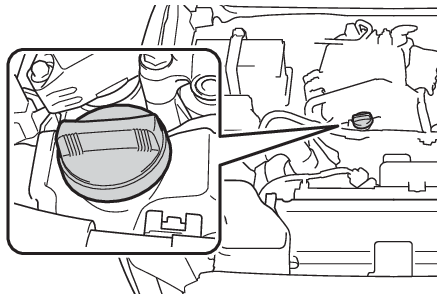
oil level exceeds the refill upper limit mark, contact your Toyota dealer.Adding engine oilChecking the oil type and preparing the items neededMake sure to check the oil type and prepare the items needed before adding oil.Engine oil selectionLubrication systemOil quantity (Low level mark Refill upper limit mark)1.5 qt. (1.4 L, 1.2 Imp.qt.)ItemsClean funnelAdding engine oilIf the oil level is below or near the low level mark, add engine oil of the same type
as that already in the engine.Remove the oil filler cap by turning it counterclockwise.Add engine oil slowly, checking the dipstick.Make sure that the oil level does not exceed the refill upper limit mark and is between
the low level mark and refill upper limit mark.Low level markRefill upper limit markThe shape of the dipstick may differ depending on the type of vehicle or engine.Install the oil filler cap by turning it clockwise.Note:Engine oil maintenance dataAfter changing the engine oilThe engine oil maintenance data should be reset. Perform the following procedures:Vehicles with 7-inch displayPress
or
of the meter control switch to select
.Press
or
to select “
Vehicle Settings” and then press and hold
.Press
/
to select “
Oil Maintenance” and then press
.Press
/
to select “
Yes” and then press
.Vehicles with 12.3-inch displayPress and hold
to display the cursor on the content display area (center) of the multi-information
display. (Changing the meter display)Press
or
of the meter control switches to select “
Settings” and then press
.Press
or
to select “
Vehicle Settings” and then press and hold
.Press
or
to select “
Oil Maintenance” and then press
.Press
or
to select “
Yes” and then press
.A message will be displayed on the multi-information display when the reset procedure
has been completed.Warning:Used engine oilUsed engine oil contains potentially harmful contaminants which may cause skin disorders
such as inflammation and skin cancer, so care should be taken to avoid prolonged and
repeated contact. To remove used engine oil from your skin, wash thoroughly with soap
and water.Dispose of used oil and filters only in a safe and acceptable manner. Do not dispose
of used oil and filters in household trash, in sewers or onto the ground. Call your
Toyota dealer, service station or auto parts store for information concerning recycling
or disposal.Do not leave used engine oil within the reach of children.Notice:When replacing the engine oilBe careful not to spill engine oil on the vehicle components.Avoid overfilling, or the engine could be damaged.Check the oil level on the dipstick every time you refill the vehicle.Be sure the engine oil filler cap is properly tightened.Engine coolant
CheckingEngine coolantCoolant
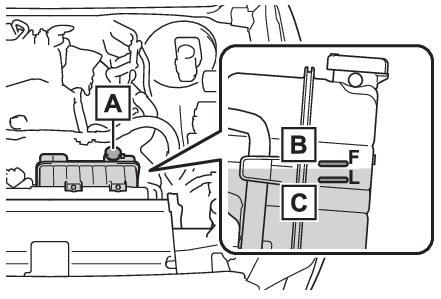
CheckingCoolantCooling systemChecking the coolantThe coolant level is satisfactory if it is between the “
F” and “
L” lines on the reservoir when the engine is cold.Reservoir cap“
F” line“
L” lineIf the level is on or below the “
L” line, add coolant up to the “
F” line. (If your vehicle overheats)Note:Coolant selectionOnly use “
Toyota Super Long Life Coolant” or a similar high quality ethylene glycol based non-silicate, non-amine, non-nitrite,
and non-borate coolant with long-life hybrid organic acid technology.U.S.A.: “
Toyota Super Long Life Coolant” is a mixture of 50% coolant and 50% deionized water.(Minimum temperature: -31°F [‑35°C])Canada: “
Toyota Super Long Life Coolant” is a mixture of 55% coolant and 45% deionized water.(Minimum temperature: -44°F [‑42°C])For more details about coolant, contact your Toyota dealer.If the coolant level drops within a short time of replenishingVisually check the radiator, hoses, engine coolant reservoir cap, drain cock and water
pump.If you cannot find a leak, have your Toyota dealer test the cap and check for leaks
in the cooling system.Warning:When the engine is hotDo not remove the coolant reservoir cap.The cooling system may be under pressure and
may spray hot coolant if the cap is removed, causing serious injuries, such as burns.Notice:When adding coolantCoolant is neither plain water nor straight antifreeze. The correct mixture of water
and antifreeze must be used to provide proper lubrication, corrosion protection and
cooling. Be sure to read the antifreeze or coolant label.If you spill coolantBe sure to wash it off with water to prevent it from damaging parts or paint.RadiatorCondenserIntercoolerChecking the radiator, condenser and intercoolerCheck the radiator, condenser and intercooler and clear away any foreign objects.If
either of the above parts is extremely dirty or you are not sure of their condition,
have your vehicle inspected by your Toyota dealer.Warning:When the engine is hotDo not touch the radiator or intercooler as they may be hot and cause serious injuries,
such as burns.When the electric cooling fan is operatingDo not touch the engine compartment.With the engine switch in ON, the electric cooling
fan may automatically start to run if the air conditioning is on and/or the coolant
temperature is high. Be sure the engine switch is off when working near the electric
cooling fan or radiator grille.The electric cooling fan may working for a while even
after the engine switch is off.Brake
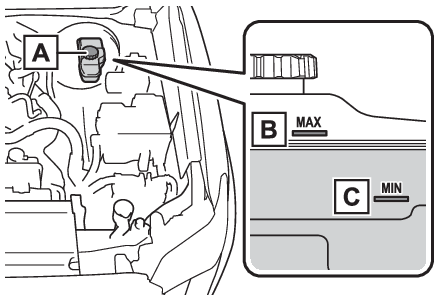
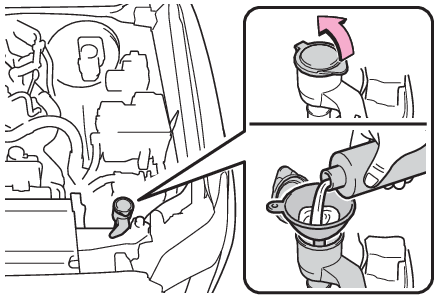
FluidChecking and adding the brake fluidChecking fluid levelThe brake fluid level should be between the “
MAX” and “
MIN” lines on the tank.Brake fluid reservoir cap“
MAX” line“
MIN” lineAdding fluidMake sure to check the fluid type and prepare the necessary item.Fluid typeFMVSS No.116 DOT 3 or SAE J1703 brake fluidFMVSS No.116 DOT 4 or SAE J1704 brake fluidItemClean funnelNote:Brake fluid can absorb moisture from the airExcess moisture in the brake fluid can cause a dangerous loss of braking efficiency.
Use only newly opened brake fluid.Warning:When filling the reservoirTake care as brake fluid can harm your hands and eyes and damage painted surfaces.If
fluid gets on your hands or in your eyes, flush the affected area with clean water
immediately.If you still experience discomfort, see a doctor.Notice:If the fluid level is low or highIt is normal for the brake fluid level to go down slightly as the brake pads wear
out or when the fluid level in the accumulator is high.If the reservoir needs frequent
refilling, there may be a serious problem.Battery
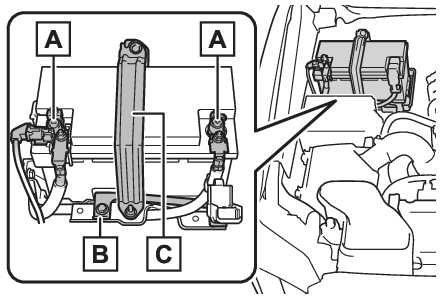
Battery checkingChecking the batteryCheck the battery as follows.Battery exteriorMake sure that the battery terminals are not corroded and that there are no loose
connections, cracks, or loose clamps.TerminalsHold-down clampBracketNote:Before rechargingWhen recharging, the battery produces hydrogen gas which is flammable and explosive.
Therefore, observe the following precautions before recharging:If recharging with the battery installed on the vehicle, be sure to disconnect the
ground cable.Make sure the power switch on the charger is off when connecting and disconnecting
the charger cables to the battery.After recharging/reconnecting the batteryThe engine may not start. Follow the procedure below to initialize the system.Shift the shift lever to P (automatic transmission) or depress the brake pedal with
the shift lever in N (manual transmission).Open and close any of the doors.Restart the engine.Unlocking the doors using the smart key system may not be possible immediately after
reconnecting the battery. If this happens, use the wireless remote control or the
mechanical key to lock/unlock the doors.Start the engine with the engine switch in ACC. The engine may not start with the
engine switch turned off. However, the engine will operate normally from the second
attempt.The engine switch mode is recorded by the vehicle. If the battery is disconnected
and reconnected, the vehicle will return the engine switch mode to the status it was
in before the battery was disconnected. Make sure to turn off the engine switch before
disconnecting the battery. Take extra care when connecting the battery if the engine
switch mode prior to the battery being disconnected is unknown.If the engine will not start even after multiple attempts, contact your Toyota dealer.Warning:Child safety
Battery precautionsChemicals in the batteryA battery contains poisonous and corrosive sulfuric acid and may produce hydrogen
gas which is flammable and explosive. To reduce the risk of death or serious injury,
take the following precautions while working on or near the battery:Do not cause sparks by touching the battery terminals with tools.Do not smoke or light a match near the battery.Avoid contact with eyes, skin and clothes.Never inhale or swallow electrolyte.Wear protective safety glasses when working near the battery.Keep children away from the battery.Where to safely charge the batteryAlways charge the battery in an open area. Do not charge the battery in a garage or
closed room where there is not sufficient ventilation.Emergency measures regarding electrolyteIf electrolyte gets in your eyesFlush your eyes with clean water for at least 15 minutes
and get immediate medical attention. If possible, continue to apply water with a sponge
or cloth while traveling to the nearest medical facility.If electrolyte gets on your skinWash the affected area thoroughly. If you feel pain
or burning, get medical attention immediately.If electrolyte gets on your clothesIt can soak through clothing on to your skin. Immediately
take off the clothing and follow the procedure above if necessary.If you accidentally swallow electrolyteDrink a large quantity of water or milk. Get
emergency medical attention immediately.When disconnecting the batteryDo not disconnect the negative (-) terminal on the body side. The disconnected negative
(-) terminal may touch the positive (+) terminal, which may cause a short and result
in death or serious injury.Notice:When recharging the batteryNever recharge the battery while the engine is running. Also, be sure all accessories
are turned off.Washer
AddingFluid
WasherAdding the washer fluidA washer does not work.The warning message appears on the multi-information display.Warning:When adding washer fluidDo not add washer fluid when the engine is hot or operating as washer fluid contains
alcohol and may catch fire if spilled on the engine, etc.Notice:Do not use any fluid other than washer fluidDo not use soapy water or antifreeze instead of washer fluid.Doing so may cause streaking
on the vehicle’s painted surfaces, as well as damaging the pump leading to problems
of the washer fluid not spraying.Diluting washer fluidDilute washer fluid with water as necessary.Refer to the freezing temperatures listed
on the label of the washer fluid bottle.