Towing
Emergency towingEmergency, in case of
If your vehicle needs to be towedIf your vehicle needs to be towedIf towing is necessary, we recommend having your vehicle towed by your Toyota dealer
or commercial towing service, using a wheel-lift type truck or flatbed truck.Use a safety chain system for all towing, and abide by all state/provincial and local
laws.Situations when it is necessary to contact dealers before towingThe following may indicate a problem with your transmission. Contact your Toyota dealer
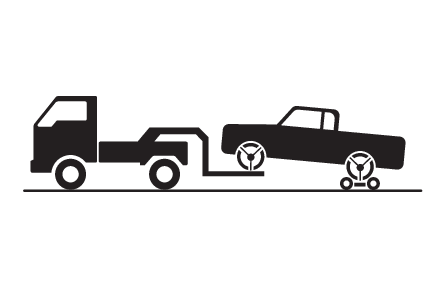
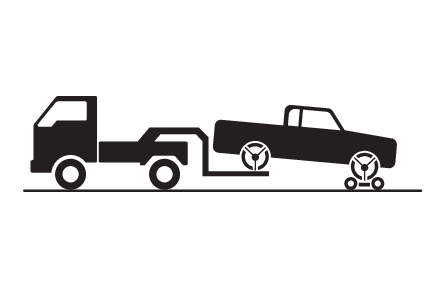
or commercial towing service before towing.The engine is running but the vehicle does not move.The vehicle makes an abnormal sound.Towing with a wheel-lift type truckFrom the frontUse a towing dolly under the rear wheels.From the rearUse a towing dolly under the front wheels.Warning:Observe the following precautions.Failure to do so may result in death or serious
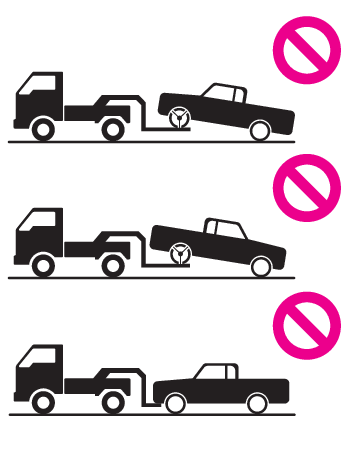
injury.When towing the vehicle2WD modelsBe sure to transport the vehicle with all four wheels raised off the ground. If the
vehicle is towed with the tires contacting the ground, the drivetrain and related
parts may be damaged or an accident may occur due to a change in direction of the
vehicle.4WD modelsBe sure to transport the vehicle with all four wheels raised off the ground. If the
vehicle is towed with the tires contacting the ground, the drivetrain or related parts
may be damaged, the vehicle may fly off the truck.Notice:To prevent damage to the vehicle when towing using a wheel-lift type truckDo not tow the vehicle from the rear when the engine switch is off. The steering lock
mechanism is not strong enough to hold the front wheels straight.When raising the vehicle, ensure adequate ground clearance for towing at the opposite
end of the raised vehicle. Without adequate clearance, the vehicle could be damaged
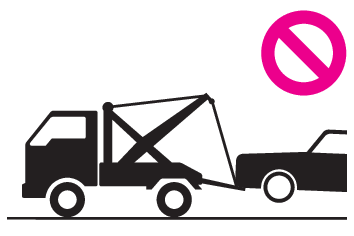
while being towed.Towing with a sling-type truckDo not tow with a sling-type truck to prevent body damage.Using a flatbed truckWhen using a flat-bed truck to transport the vehicle, use tire strapping belts. Refer
to the owner’s manual of the flat-bed truck for the tire strapping method.In order to suppress vehicle movement during transportation, set the parking brake
and turn the engine switch off.Emergency towingIf a tow truck is not available in an emergency, your vehicle may be temporarily towed
using cables or chains secured to the emergency towing eyelets. This should only be
attempted on hard surfaced roads for at most 50 miles (80 km) at under 18 mph (30
km/h).A driver must be in the vehicle to steer and operate the brakes. The vehicle’s wheels,
drive train, axles, steering and brakes must be in good condition.For vehicles with an automatic transmission, only the front towing eyelets may be
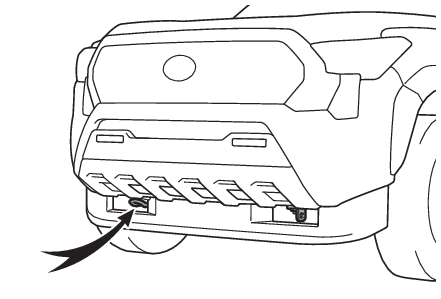
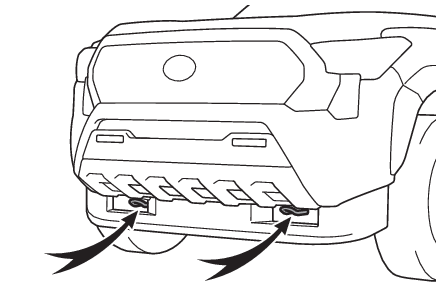
used.Emergency towing procedureSecurely attach cables or chains to the towing hook(s).Take care not to damage the vehicle body.Type AType BEnter the vehicle being towed and start the engine.If the engine does not start, turn the engine switch to ON.4WD models: Put the front-wheel drive control switch in “
2H”.Shift the shift lever to N and release the parking brake.Turn automatic mode off. (Turning the automatic mode off)Vehicles with an automatic transmission: When the shift lever cannot be shifted: If the shift lever cannot be shifted from PNote:While towingIf the engine is not running, the power assist for the brakes and steering will not
function, making steering and braking more difficult.Warning:Observe the following precautions. Failure to do so may result in death or serious
injury.While towingWhen towing using cables or chains, avoid sudden starts, etc. which place excessive
stress on the towing eyelets, cables or chains. The towing eyelets, cables or chains
may become damaged, broken debris may hit people, and cause serious damage.Do not turn the engine switch off. There is a possibility that the steering wheel
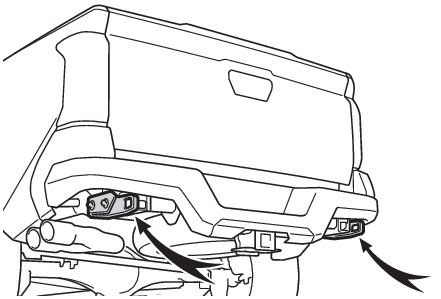
is locked and cannot be operated.Notice:To prevent damage to the vehicle during emergency towingDo not secure cables or chains to the suspension components.Rear recovery points (if equipped)Warning:These recovery points are only intended to recover the vehicle when stranded in an
off-road or slippery condition. The recovery points shall not be used for towing items
behind the vehicle or to tow the vehicle on-road.Note:While towingAlign the tow vehicle with the vehicle so that the recovery strap is pulled straight
toward the rearDo not apply a load to the recovery points that is greater than the gross vehicle
weight rating (GVWR)Ensure the recovery strap has no slack in it prior to pulling the vehicleKeep bystanders out of the path of recovery and safely distanced from vehicles