Cargo and luggageCargo and luggageTake notice of the following information about storage precautions, cargo capacity
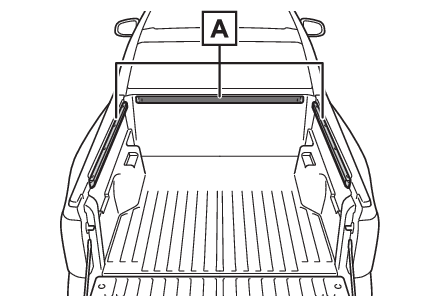
and load:Deck railsTo use the deck rails, you must install genuine Toyota accessories or their equivalent
for the deck rails.Follow the manufacturer’s instructions and precautions when installing a genuine Toyota
accessory or equivalent.Side railsWarning:When you secure cargo with the deck railsBe sure to follow the instructions below in order to avoid the cargo coming loose.Do not install accessories (tie-down cleats, storage boxes, etc.) at more than the
following number of locations per deck rail.Side rail:Short deck—ax. 3 locationsLong deck—ax. 4 locationsSpread out tie-down/support locations evenly along the length of the rails.Do not exceed a total tensile load of 440 lb. (200 kg) per deck rail.To prevent luggage or cargo from sliding forward during braking, make sure the deck
rail accessories such as storage box are securely attached on the deck rails.Capacity and distributionCargo capacity depends on the total weight of the occupants.(Cargo capacity) = (Total load capacity) — (Total weight of occupants)Steps for Determining Correct Load Limit —(1) Locate the statement “The combined weight of occupants and cargo should never
exceed XXX kg or XXX lbs.” on your vehicle’s placard.(2) Determine the combined weight of the driver and passengers that will be riding
in your vehicle.(3) Subtract the combined weight of the driver and passengers from XXX kg or XXX lbs.(4) The resulting figure equals the available amount of cargo and luggage load capacity.For example, if the “XXX” amount equals 1400 lbs. and there will be five 150 lb passengers
in your vehicle, the amount of available cargo and luggage load capacity is 650 lbs.
(1400 − 750 (5 150) = 650 lbs.)(5) Determine the combined weight of luggage and cargo being loaded on the vehicle.
That weight may not safely exceed the available cargo and luggage load capacity calculated
in Step 4.(6) If your vehicle will be towing a trailer, load from your trailer will be transferred
to your vehicle. Consult this manual to determine how this reduces the available cargo
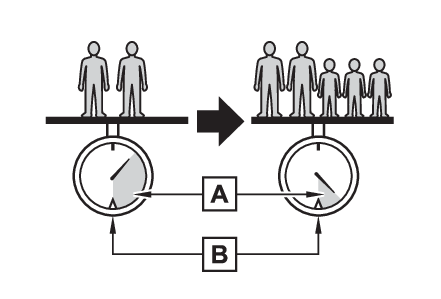
and luggage load capacity of your vehicle. (Vehicle load limits)Calculation formula for your vehicleCargo capacityTotal load capacity (vehicle capacity weight) (Vehicle capacity weight)When 2 people with the combined weight of A lb. (kg) are riding in your vehicle, which
has a total load capacity (vehicle capacity weight) of B lb. (kg), the available amount
of cargo and luggage load capacity will be C lb. (kg) as follows:B*2 lb. (kg) - A*1 lb. (kg) = C*3 lb. (kg)*1A =Weight of people*2B =Total load capacity*3C =Available cargo and luggage loadIn this condition, if 3 more passengers with the combined weight of D lb. (kg) get
on, the available cargo and luggage load will be reduced E lb. (kg) as follows:C lb. (kg) - D*4 lb. (kg) = E*5 lb. (kg)*4D =Additional weight of people*5E =Available cargo and luggage loadAs shown in the example above, if the number of occupants increases, the cargo and
luggage load will be reduced by an amount that equals the increased weight due to
the additional occupants. In other words, if an increase in the number of occupants
causes an excess of the total load capacity (combined weight of occupants plus cargo
and luggage load), you must reduce the cargo and luggage on your vehicle.Warning:Things that must not be carried in the luggage compartmentThe following things may cause a fire if loaded in the luggage compartment:Receptacles containing gasolineAerosol cansStorage precautionsObserve the following precautions.Failure to do so may prevent the pedals from being
depressed properly, may block the driver’s vision, or may result in items hitting
the driver or passengers, possibly causing an accident.Do not stack anything behind the front seats higher than the seatbacks.Do not place cargo or luggage in or on the following locations.At the feet of the driverOn the front passenger or rear seats (when stacking items)On the instrument panelOn the dashboardOn the auxiliary box or tray that has no lidSecure all items in the occupant compartment.Never allow anyone to ride in the rear deck. It is not designed for passengers. They
should ride in their seats with their seat belts properly fastened. Otherwise, they
are much more likely to suffer death or serious bodily injury, in the event of sudden
braking, sudden swerving or an accident.Capacity and distributionDo not exceed the maximum axle weight rating or the total vehicle weight rating.Even if the total load of occupant’s weight and the cargo load is less than the total
load capacity, do not apply the load unevenly. Improper loading may cause deterioration
of steering or braking control which may cause death or serious injury.