Automatic transmissionShift lever
Automatic transmissionTransmission
Automatic transmissionAutomatic transmission
TOW HAUL switchAutomatic transmission**if equippedSelect the shift position depending on your purpose and situation.Shift position purpose and functions
Shift position
Objective or function
P
Parking the vehicle/starting the engine
R
Reversing
N
Neutral (Condition in which the power is not transmitted)
*1Shifting to the D position allows the system to select a gear suitable for the driving
conditions. Setting the shift lever to the D position is recommended for normal driving.*2Selecting shift ranges using S mode restricts the upper limit of the possible gear
ranges, controls engine braking force, and prevents unnecessary upshifting.Note:Driving on a downhillOn declines, there may be case where the vehicle shifts down automatically to obtain
engine braking. As a result of the downshifting, the engine speed may increase.To protect the automatic transmissionIf the tires spin continually when the vehicle becomes stuck in mud, dirt or snow,
or if the accelerator pedal is depressed and released repeatedly while driving, the
automatic transmission temperature may become too high and the automatic transmission
may be damaged.To avoid damaging the automatic transmission, the system may temporarily
lock the gear. If the automatic transmission temperature falls, the gear locking is
canceled and the automatic transmission is returned to the normal operation.If the automatic transmission fluid temperature is high, “
Transmission Oil Temp. High Stop in a Safe Place and See Owner’s Manual” will be displayed on the multi-information display. Immediately stop the vehicle
in a safe place, shift the shift lever to P and wait until the warning message go
off. If the warning message go off, you may start the vehicle again. If the warning
message do not go off, contact your Toyota dealer.When driving with the dynamic radar cruise control activatedEven when switching the driving mode to sport mode with the intent of enabling engine
braking, engine braking will not occur because dynamic radar cruise control will not
be canceled. (Driving mode select switch*)While driving in S mode, downshifting to 6, 5, 4, or 3 is possible based on vehicle
speed. (Changing shift ranges in S mode)Restraining sudden start (Drive-Start Control)Sudden start restraint control (Drive-Start Control [DSC]) (vehicles with an automatic
transmission)AI-SHIFTAI-SHIFTThe AI-SHIFT automatically selects the suitable gear according to driver operation
and driving conditions.AI-SHIFT automatically operates when the shift lever is in
D or S.Warning:When driving on slippery road surfacesDo not accelerate or shift gears suddenly.Sudden changes in engine braking may cause
the vehicle to spin or skid, resulting in an accident.Lever
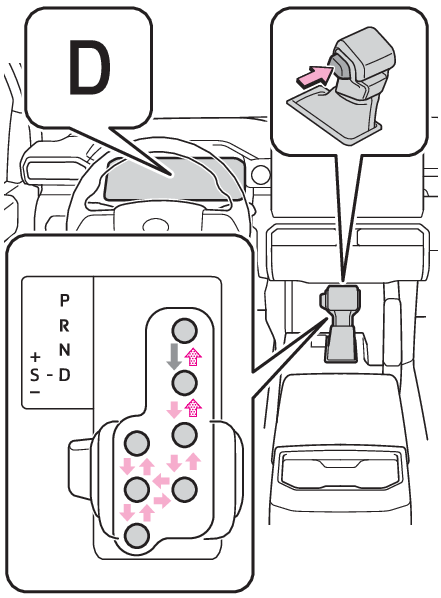
Shift leverShift leverShifting the shift lever While the engine switch is in ON and the brake pedal depressed*, shift the shift lever while pushing the shift release button on the shift knob. Shift the shift lever while pushing the shift release button on the shift knob. Shift the shift lever normally.When shifting the shift lever between P and D, make sure that the vehicle is completely
stopped.*For the vehicle to be able to be shifted from P, the brake pedal must be depressed
before the shift release button is pushed. If the shift release button is pushed first,
the shift lock will not be released.Note:Shift lock systemShift lock systemThe shift lock system is a system to prevent accidental operation of the shift lever
in starting.The shift lever can be shifted from P only when the engine switch is in
ON, the brake pedal is depressed and the shift release button is pushed.Shift lever
If the shift lever cannot be shifted from PAutomatic transmission
If the shift lever cannot be shifted from PIf the shift lever cannot be shifted from PFirst, check whether the brake pedal is being depressed.If the shift lever cannot
be shifted even though the brake pedal is depressed and the shift release button is
pushed, there may be a problem with the shift lock system. Have the vehicle inspected
by your Toyota dealer immediately.The following steps may be used as an emergency
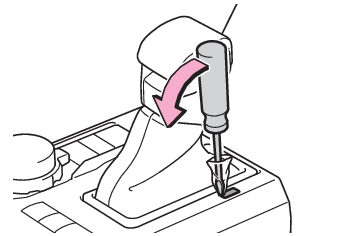
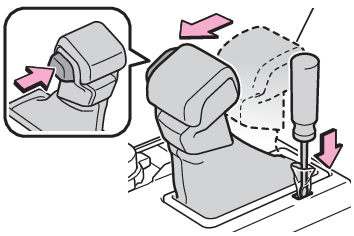
measure to ensure that the shift lever can be shifted.Releasing the shift lock:Set the parking brake.Turn the engine switch off.Depress the brake pedal.Pry the cover up with a flathead screwdriver or equivalent tool.To prevent damage
to the cover, cover the tip of the screwdriver with a rag.Press and hold the shift lock override button and then push the button on the shift
knob.The shift lever can be shifted while both buttons are pressed.Warning:To prevent an accident when releasing the shift lockBefore pressing the shift lock override button, make sure to set the parking brake
and depress the brake pedal.If the accelerator pedal is accidentally depressed instead
of the brake pedal when the shift lock override button is pressed and the shift lever
is shifted out of P, the vehicle may suddenly start, possibly leading to an accident
resulting in death or serious injury.Selecting the driving modeDrive modeDriving mode select switch*Automatic transmission
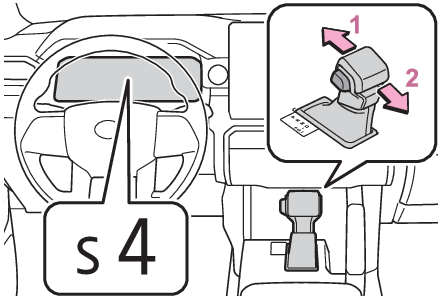
S modeChanging shift ranges in S modeWhen the shift lever is in the S position, the shift lever can be operated as follows:UpshiftingDownshiftingThe selected shift range, from S1 to S8 will be displayed on the multi-information
display.The initial shift range in S mode is set automatically to 3, 4, 5 or 6 according to
vehicle speed.However, the initial shift range may be set to 4 if AI-SHIFT has operated while the
shift lever was in the D position. (AI-SHIFT)Note:S modeYou can choose from 8 levels of accelerating force and engine braking force.A lower shift range will provide greater accelerating force and engine braking force
than a higher shift range, and the engine revolutions will also increase.To prevent the engine from overrevving, upshifting may automatically occur.To protect the automatic transmission, a function is adopted that automatically selects
a higher shift range when the fluid temperature is high.When the shift range is 7 or lower, holding the shift lever toward “
+” sets the shift range to 8.Warning buzzers
DownshiftingDownshifting restriction warning buzzerTo help ensure safety and driving performance, downshifting operation may sometimes
be restricted. In some circumstances, downshifting may not be possible even when the
shift lever is operated. (A buzzer will sound twice.)If the S indicator does not come on even after shifting the shift lever to SThis may indicate a malfunction in the automatic transmission system. Have the vehicle
inspected by your Toyota dealer immediately.Switches
TOW HAUL switchMode select switch
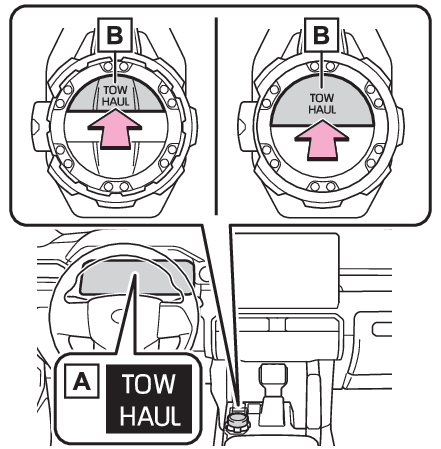
TOW HAUL switchTOW HAUL switch“
TOW HAUL” switch (if equipped)Use “
TOW HAUL” mode when pulling a trailer or hauling a heavy load. Activating “
TOW HAUL” mode is changes engine, transmission, and steering to be more suitable when pulling
a trailer.“
TOW HAUL” indicator“
TOW HAUL” switchPress the “
TOW HAUL” switchThe “
TOW HAUL” indicator will come on.Press the switch once more to cancel the mode.Note:Automatic deactivation of “
TOW HAUL” mode“
TOW HAUL” mode is deactivated the following conditions:When the front-wheel drive control switch is in “
4L”When driving mode select or Multi-terrain Select (if equipped) is selectedSwitches
Power modeSwitches
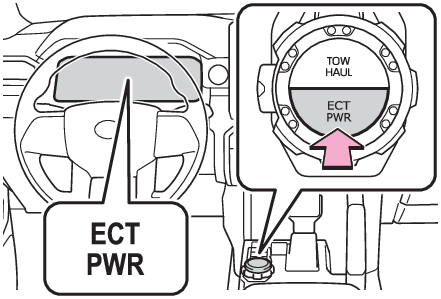
ECT PWR switchSelecting power mode (if equipped)Use when high levels of response and feeling are desirable, such as when driving in
mountainous regions.Press the “
ECT PWR” switch to select power mode.The “
ECT PWR” indicator comes on.Press the switch again to cancel power mode.