Washing and waxingCleaning
ExteriorCleaningCare
ExteriorCareCleaning and protecting the vehicle exteriorPerform cleaning in a manner appropriate to each component and its material.Cleaning instructionsWorking from top to bottom, liberally apply water to the vehicle body, wheel wells
and underside of the vehicle to remove any dirt and dust.Wash the vehicle body using a sponge or soft cloth, such as a chamois.For hard-to-remove marks, use car wash soap and rinse thoroughly with water.Wipe away any water.Wax the vehicle when the waterproof coating deteriorates.If water does not bead on a clean surface, apply wax when the vehicle body is cool.Note:Automatic car washesFold the mirrors before washing the vehicle.Start washing from the front of the vehicle. Extend the mirrors before driving.Brushes used in automatic car washes may scratch the vehicle surface, parts (wheel,
etc.) and harm your vehicle’s paint.High pressure car washesAs water may enter the cabin, do not bring the nozzle tip near the gaps around the
doors or perimeter of the windows, or spray these areas continuously.When using a car washIf the door handle becomes wet while the electronic key is within the effective range,
the door may lock and unlock repeatedly. In that case, follow the following correction
procedures to wash the vehicle:Place the key in a position 6 ft. (2 m) or more separate from the vehicle while the
vehicle is being washed. (Take care to ensure that the key is not stolen.)Set the electronic key to battery-saving mode to disable the Smart key system. (Battery-saving function)Cleaning
Aluminum wheelsCare
Aluminum wheelsCleaning
Aluminum wheel ornamentsCare
Aluminum wheel ornamentsWheels and wheel ornamentsRemove any dirt immediately by using a neutral detergent.Wash detergent off with water immediately after use.To protect the paint from damage, make sure to observe the following precautions.Do not use acidic, alkaline or abrasive detergentDo not use hard brushesDo not use detergent on the wheels when they are hot, such as after driving or parking
in hot weatherBrake pads and calipersRust may form if the vehicle is parked with wet brake pads or disc rotors, causing
them to stick. Before parking the vehicle after it is washed, drive slowly and apply
the brakes several times to dry the parts.Bumpers and wheel arch moldingsDo not scrub with abrasive cleaners.Plated portionsIf dirt cannot be removed, clean the parts as follows:Use a soft cloth dampened with an approximately 5% solution of neutral detergent and
water to clean the dirt off.Wipe the surface with a dry, soft cloth to remove any remaining moisture.To remove oily deposits, use alcohol wet wipes or a similar product.Warning:When washing the vehicleDo not apply water to the inside of the engine compartment. Doing so may cause the
electrical components, etc. to catch fire.Precautions regarding the exhaust pipeExhaust gases cause the exhaust pipe to become quite hot. When washing the vehicle,
be careful not to touch the pipe until it has cooled sufficiently, as touching hot
exhaust pipe can cause burns.Precaution regarding the front and rear bumpersIf the paint of the front or rear bumper is chipped or scratched, the following systems
may not function correctly. If this occurs, consult your Toyota dealer.BSM (if equipped)RCTA (if equipped)PKSB (if equipped)Intuitive parking assist (if equipped)Toyota Safety Sense 3.0Notice:To prevent paint deterioration and corrosion on the body and components (aluminum
wheels, etc.)Wash the vehicle immediately in the following cases:After driving near the sea coastAfter driving on salted roadsIf coal tar or tree sap is present on the paint surfaceIf dead insects, insect droppings or bird droppings are present on the paint surfaceAfter driving in an area contaminated with soot, oily smoke, mine dust, iron powder
or chemical substancesIf the vehicle becomes heavily soiled with dust or mudIf liquids such as benzene and gasoline are spilled on the paint surfaceIf the paint is chipped or scratched, have it repaired immediately.To prevent the wheels from corroding, remove any dirt and store in a place with low
humidity when storing the wheels.Cleaning the exterior lightsWash carefully. Do not use organic substances or scrub with a hard brush.This may
damage the surfaces of the lights.Do not apply wax to the surfaces of the lights.Wax may cause damage to the lenses.When using a high pressure car washWhen washing the vehicle, do not spray the camera or its surrounding area directly
with a high pressure washer. Shock applied from high pressure water may cause the
device to not operate normally.Do not spray water directly on the radar which is equipped behind the emblem. Otherwise
it may cause the device to be damaged.Do not bring the nozzle tip close to boots (rubber or resin manufactured cover), connectors
or the following parts. The parts may be damaged if they come into contact with high-pressure
water.Traction related partsSteering partsSuspension partsBrake partsKeep the cleaning nozzle at least 11.9 in. (30 cm) away from the vehicle body. Otherwise
resin section, such as moldings and bumpers, may be deformed and damaged.Also, do not continuously hold the nozzle in the same place.Do not spray the lower part of the windshield continuously.If water enters the air conditioning system intake located near the lower part of
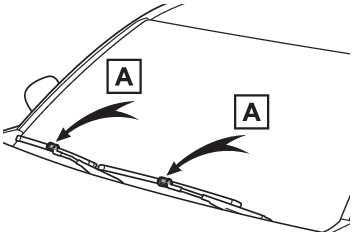
the windshield, the air conditioning system may not operate correctly.Do not wash the underside of the vehicle using a high pressure car washer.When raising the windshield wiper armsMake sure to hold the hook parts of the wiper arms to raise them.Do not hold only
the wiper blades when raising them, or it may cause deformation of the wiper blades.Hook partsCleaning the high mounted stoplight and cargo lampsWhen using high-pressured car washers, the tip of the nozzle should be at least 20
in. (50 cm) from the car body. Water can seep into the lamp housing or the vehicle
cabin if the nozzle is closer to the car body.